


The latest CME reached Earth at 19:17 UTC on November 12. NOAA reports that we appear to have been struck by the edge of the eruption.
As of November 13, conditions are described as weakening but variable. Although the peak of the latest auroral activity seems to have passed, continued high solar wind speeds and shifts in the magnetic field orientation may still drive geomagnetic storms between G1 and G3 levels.
Latest geomagnetic storm watches:
- November 13: G3 (strong)
- November 14: G1 (minor)
Aurora Watch
Incredible things are happening in the sky. Our previous updates have been tracking the latest developments from the Sun, which has been sending a flurry of solar flares and coronal mass ejections (CMEs) our way.
Yesterday (November 11), NOAA upgraded the geomagnetic storm watch to G4 (severe) for November 12—the G4 threshold was indeed reached at 01:20 UTC, and continued from there.
Auroras were visible across much of the United States for those with clear skies, with auroras spotted as far south as the US-Mexico border, and even into Mexico. Northern lights sightings were also reported in Scandinavia, the UK, France, and Germany.

Spectacular aurora activity is likely to continue over the next few days if conditions align, so be sure to look up for the chance to see the northern or southern lights glowing in the sky.
Where can I see the aurora tonight?What’s Causing the Latest Aurora Activity?
Early on November 11, the Sun unleashed an X5.1 solar flare, which NOAA reports may be one of the strongest of the current solar cycle. Soon after, the Sun launched a CME associated with this flare, which is heading toward Earth.
There have been three X-class flares—the most powerful category of solar flare—in the past week, all accompanied by CMEs with Earth-directed components. Like all CMEs, these ejections carry charged particles and a magnetic field. If conditions align, the magnetic field can connect with ours, and charged particles can interact with gases in our atmosphere, producing the mesmerizing lights that we see in the sky as the aurora.
The CMEs from the X1.2 and X1.7 solar flares have resulted in the G4 activity that we’re experiencing now on November 12. Scientists and aurora chasers are still waiting for the CME from the X5.1 solar flare. NOAA reports that this latest CME is the fastest and most energetic of the recent eruptions and that there is the potential for G4-level geomagnetic activity when it impacts Earth’s magnetosphere—our planet’s invisible shield.
How the equinox affects aurora activityWhere Can I See the Aurora?
Aurora visibility will depend on the overall geomagnetic levels and potential shorter bursts of activity. In the Northern Hemisphere, the northern lights (aurora borealis) could be visible farther south than usual in these locations:
- North America: Canada and the northern to central United States—potentially as low as Alabama and northern California, according to NOAA.
- Europe: Scandinavia, large parts of the UK and Russia, and countries in central Europe such as Germany and Poland.
In the Southern Hemisphere, the southern lights (aurora australis) could be visible further north than usual in these locations:
- Chile and Argentina: The southern parts of the countries.
- Australia and New Zealand: The southern coast of Australia, Tasmania, and New Zealand could all see activity.
Keep in mind that these are predictions. To maximize your chance of seeing the northern or southern lights, check local aurora watch groups for real-time updates in your area.
Sunrise and sunset times for your locationWhy Auroras Happen
When particles from the Sun reach Earth, they interact with gases in our atmosphere, like oxygen and nitrogen. This creates glowing curtains of light called auroras, usually green, but sometimes red, purple, or even blue, depending on the gases and the energy involved.
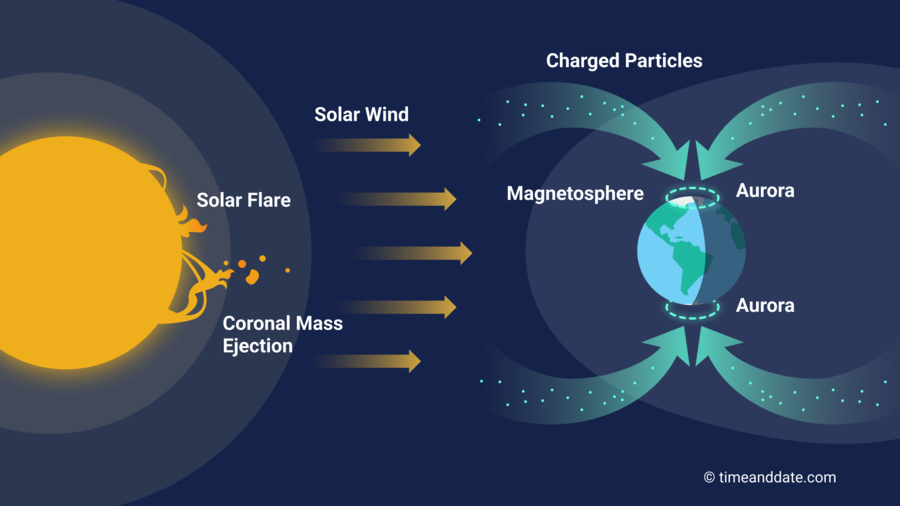
We’re currently in a period known as solar maximum, the most active phase in the Sun’s 11-year solar cycle, marked by increased sunspots and frequent solar eruptions. That means that, during solar maximum, solar flares and CMEs are more likely, making beautiful auroras more likely too.

What Are Coronal Holes?
Coronal holes are regions on the Sun that look darker in extreme ultraviolet (EUV) and X-ray images. They appear this way because they are cooler and less dense than the surrounding plasma. In these areas, the Sun’s magnetic field lines open outward into space instead of looping back to the surface.
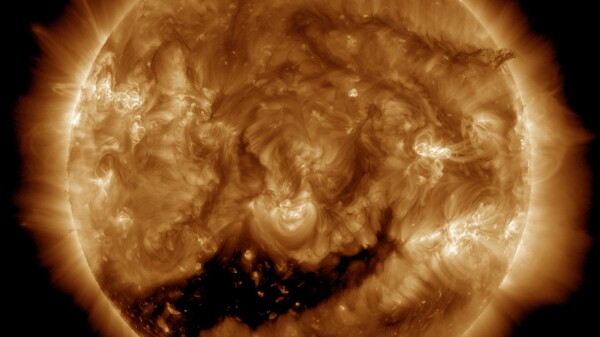
You can think of them like “channels” in the Sun’s outer atmosphere, the corona, where solar wind can stream out more freely. The solar wind always flows from the Sun, but coronal holes produce faster streams. These high-speed streams temporarily enhance the speed and intensity of this ever-flowing solar wind.
When these fast solar wind streams reach Earth, they can interact with our planet’s magnetic field, sometimes sparking geomagnetic activity and brighter auroras—especially if the solar wind carries a strong southward magnetic component, which is more likely around the equinoxes.
While generally less dramatic than coronal mass ejections (CMEs), these streams can still produce noticeable space weather effects.
Coronal holes can persist for several solar rotations, so their impacts can recur roughly every 27 days—the time it takes the Sun to spin once on its axis at the equator.
What Are Coronal Mass Ejections?
Coronal mass ejections are massive bubbles of hot plasma and magnetic fields ejected from the Sun into space.
CMEs often occur alongside solar flares, which are bursts of energy from the Sun, but unlike flares, CMEs involve the physical expulsion of plasma and magnetic fields. When Earth-directed, these solar storms can interact with our planet’s magnetic field, producing auroras and geomagnetic storms.
We can usually see the effects of a CME on Earth within a couple of days.
What Are the Different Types of Flares?
Not all solar flares are created equal—scientists group them into different categories based on their strength:
- A-class and B-class flares are very small. They don’t have much impact on Earth.
- C-class flares are a little stronger. They usually cause minor effects, if any.
- M-class flares are medium-sized. These can sometimes cause radio blackouts near Earth’s poles and create brighter auroras if linked to a CME.
- X-class flares are the biggest and most powerful and can lead to widespread radio blackouts. If accompanied by a CME, they can also produce strong geomagnetic storms and spectacular auroras even far from the poles.
NASA explains that solar flare classes work “much like the Richter scale for earthquakes,” where each higher class is 10 times more energetic than the one before. So, an X-class flare is 10 times stronger than an M-class flare and 100 times stronger than a C-class flare.
Each class also has a scale, from 1 to 9—the higher the number, the stronger the flare, though X-class flares have no upper limit.

Solar Cycle 25: More Storms Ahead?
The current Solar Cycle 25 is well underway. With increased sunspot numbers, solar flares, and CME activity, this phase—known as solar maximum—increases the likelihood of geomagnetic storms and auroras.
NOAA and NASA confirm that the current solar cycle has been more active than initially forecast, prompting an updated prediction that it will peak earlier and at a higher intensity.
While recent data suggests that solar activity may have already peaked, scientists note that auroral activity often remains strong for several years after solar maximum, meaning some of the most spectacular northern and southern lights may still lie ahead.

Previous Updates
November 11: The Sun Unleashes One of the Strongest X flares of 2025
Our previous update was about the X1.7 solar flare that produced one of the two CMEs that are heading our way. Today, (November 11), yet another CME is on its way, triggered by an X1.2 flare that erupted just 26 hours after the X1.7.
A G2 (moderate) geomagnetic storm watch remains in place for today, and NOAA has upgraded the watch for November 12 to a G3 (strong). Auroras could be visible much farther from polar regions than usual.
Plus, the Sun has now unleashed an even larger event: an X5.1 solar flare at 10:04 UTC—which NOAA reports is likely one of the strongest flares of the current solar cycle.
November 10: Two CMEs Expected to Reach Earth Soon
The situation on November 10 is that the Sun continues to send more of its dramatic activity our way. Two coronal mass ejections (CMEs) that erupted from the Sun on November 7 and November 9 are expected to reach Earth in the coming days. The CME on November 9 was connected to an X1.7 solar flare.
NOAA has issued a G1 (minor) geomagnetic storm watch for November 10 and a G2 (moderate) watch for November 11–12. Aurora visibility may extend beyond the usual auroral zones.
November 9: What’s Causing the Latest Aurora Activity?
Big things are happening on the Sun recently, and there’s a lot to unpack about the latest geomagnetic storm forecast.
According to SWPC, this forecasted geomagnetic storm is caused by one of four notable coronal mass ejections (CMEs) that erupted from the Sun on and between November 3–5. While three of these CMEs are expected to mostly miss our planet, SWPC has reported that one has a more Earth-directed component, estimated to impact our planet’s magnetosphere today and potentially into tomorrow.
On November 4, the Sun unleashed two X-class flares, the most powerful type of solar flare. These are the first X flares since June this year. Both of them produced CMEs; however, reports indicate that the CME now heading our way may have originated not from these flares, but from an M-class flare that occurred on November 5.
With so many flares and CMEs occurring over the last few days, it’s a difficult situation to disentangle with regard to the exact timing of the CME arrivals and any potential glancing blows to our planet.
If that wasn’t enough excitement, there is also a coronal hole currently facing Earth. This means that high-speed solar wind is flowing in our direction, sending both more and faster charged particles our way, further enhancing the potential for widespread northern and southern lights.
In short, it’s not very often we get the chance to witness a G3 storm, so be sure to look up over the next few nights for the chance to see mesmerizing aurora displays.
November 9: Two CMEs Expected to Reach Earth Soon
NOAA’s Space Weather Prediction Center (SWPC) has issued a G3 (Strong) watch for November 6 and 7, with a G1 watch in place for November 8.
As of 05:27 UTC, the G3 threshold was reached; however, levels are currently G2 at the time of publication, with the potential to reach G3 again over the next couple of days.
This is exciting news for aurora chasers. At G3 levels, the northern and southern lights will likely appear in locations much farther from the usual auroral zones.
November 7: CME Reaches Earth
The first expected CME has now impacted Earth, and a G3 (strong) geomagnetic storm watch remains in place for today (November 7).
In addition, a slower CME that also erupted on November 5 is on its way and is expected to reach our planet on November 8. Because of this, the G1 (minor) watch has been upgraded to G2 (moderate) for that day.
October 31: G1 Watch in Effect for Halloween
NOAA’s Space Weather Prediction Center has issued a G1 (minor) geomagnetic storm watch in effect until 15:00 UTC today, October 31.
With the watch coinciding with Halloween, skywatchers might be treated to a ghostly glow in the night sky.
October 28: Will We See a Halloween Sky Show?
A G1 (minor) geomagnetic storm watch is in effect for October 28–30, as fast solar wind from an Earth-facing coronal hole makes its way towards our planet. The high-speed solar wind is expected to reach Earth on October 28, likely sparking G1 conditions, with potential for G2 (moderate) levels.
According to the Space Weather Prediction Center, these effects may be enhanced by a weak influence from a coronal mass ejection> (CME) that left the Sun on October 23. Conditions are expected to remain active—though perhaps not quite reaching G1 levels—until October 31, meaning there’s a chance of catching a Halloween aurora if the conditions are right and the skies are clear.
Keep in mind that these are predictions. To maximize your chance of seeing the northern or southern lights, check local aurora watch groups for real-time updates in your area.
October 30: Geomagnetic Storm Watch Upgraded to G2 Level
NOAA’s Space Weather Prediction Center has upgraded the geomagnetic storm watch to G2 (moderate) until 15:00 UTC today (October 30).
Auroras may be visible farther from the polar regions than usual. In the Northern Hemisphere, there could be northern light sightings as low as New York, Wisconsin, and Washington state, weather permitting.
October 7–8: Multiple Coronal Mass Ejections Approach Earth
A G1 (minor) geomagnetic storm watch is in effect for October 7–8, as multiple coronal mass ejections (CMEs) are currently heading toward Earth.
These CMEs are relatively slow-moving, so they are less likely to produce very intense geomagnetic storms. Still, G1 conditions remain possible. As a result, if you’re farther from the poles in the following locations, it could be worth looking up over the coming nights.
September 30: Update
Heads up, aurora chasers: NOAA has issued a G1 (minor) alert, in effect until 21:00 UTC on September 30, as conditions remain favorable for elevated aurora activity.
September 30: Auroras Spotted at Mid-Latitudes
In the early hours of September 30, NOAA issued a G3 (strong) geomagnetic storm alert due to a coronal mass ejection (CME) influencing Earth. The activity intensified quickly, and NOAA confirmed that G3 levels were reached at 05:25 UTC. The alert is expected to remain in place until 12:00 UTC.
The timing worked out well for skywatchers in North America, with auroras reported in Canada and northern US states, and even as far south as Ohio and Indiana.
Hours earlier, Europe also enjoyed strong displays during its night, with auroras spotted farther south than usual, including southern Norway and northern Germany.
September 22–23: Fast Solar Wind Stream May Light Up the Skies
NOAA has issued a G1 (minor) alertfrom September 22 due to high-speed solar wind from a coronal hole.
High-speed solar wind from the Earth-facing coronal hole began influencing our planet’s magnetic field as expected around September 22–23.
Auroras have been reported in Canada and some northern US border states, as well as in southern Norway, northern Germany, and Russia.
September 3: Storm Fades After Spectacular Auroras
The geomagnetic storm has mostly subsided, with only a G1 (minor) alert in effect for today. Last night, however, the auroras put on an incredible show, with sightings reported across North America, parts of northern and central Europe, and even New Zealand.
September 2: Auroras Surge as Storm Builds
A G3 (strong) geomagnetic alert is active; auroras may extend far beyond polar regions. G4 (severe) levels remain possible. During bursts of activity, the aurora can reach even further towards the equators than predicted.
In short, if the weather is clear, go outside and see if you can find the northern or southern lights today.
September 1: Auroras Could Shine Bright Tonight
A full-halo coronal mass ejection (CME) erupts after an M2.7-class solar flare on August 30. The Earth-facing CME is expected to arrive around September 1–2.
Some reports describe it as a “cannibal CME,” where a faster ejection overtakes an earlier one, merging into a stronger storm. This interaction raises the potential for an intensified geomagnetic storm and widespread auroras as far south as New York and London.
- 21:00 UTC: CME shock front arrived at Earth.
- 22:36 UTC: Geomagnetic storm reached G2 (moderate), sparking aurora sightings.